Book Blurb

My book, The Consort Organ and its Use in Seventeenth-Century English Music is gradually moving through the production process and will appear next year. Here is the blurb as it will appear in the Ashgate Historical Keyboard Series publicity material:

This book is the first in-depth study of the seventeenth-century English consort organ. From the refined confines of the royal court to the lively entertainments of the post-Restoration music-houses, in aristocratic households, universities, and royal Catholic chapels, the consort organ found itself employed in a colourful range of instrumental and vocal repertoire involving the leading composers and musicians of its day. Drawing on extensive primary sources, the book traces the story of the English secular organ during the Jacobean and Stuart periods, contrasting its role with that of the contemporary church organ and placing its usage in the context of wider European trends in chamber and devotional music. The book focusses on the instrument’s organology and varied playing contexts, as well as providing a detailed picture of performance practices relating to the organ’s use in the string consort and devotional vocal repertoires. David Force offers valuable insights into the approaches taken by secular organists of the time in interpreting musical texts at the keyboard and seeks to widen awareness of a neglected instrument in ways that are applicable both to practising musicians and to those interested in the repertoire.

JBIOS49

I recently took on the role of Executive Editor of the Journal of the Institute of British Organ Studies (click here for more info on BIOS) and have edited JBIOS49, which is landing this week on the doormats of people interested in British organ history and culture across the world. Copies can be purchased here.

It includes my latest article ”Lessor orgaynes in the quyere’: Reassessing the Chair Organ in Seventeenth-Century English Contexts’ in which I discuss the role of small organs in the liturgy of the time, and discuss the relationship between these and the larger ‘double’ organs that emerged during the early seventeenth century. One particularly interesting finding of this latter aspect (which I wasn’t expecting and which contradicts the standard histories of the organ published hitherto) is that, in many cases, the two parts of the double organ (great and chair divisions) were quite seperate and independent instruments, each used individually for a specific set of liturgical roles. Even more surprisingly, perhaps, such arrangements persisted in some places well into the second half of the century.

I will also be looking after the next Journal, which celebrates 50 years of BIOS, whereafter we will return to the practice of inviting guest editors to take the helm. Interested contributors are welcome to contact me at any time with ideas for articles.

C17 secular organ references updated, extant organs list added

I have added some new references  to secular organs from the C17 to the list. Several of these relate to instruments that were observed by foreign visitors to the domestic spaces of the late Tudor and Jacobean royal palaces. Some of these organs are rather interesting, and included features such as clockwork player mechanisms, automata, and multiple keyboards. I am currently looking further into all this and hope to publish some findings later in the year.

I have also added a list of the extant consort organ materials, listing instruments and the various fragments that survive. It’s very much an ongoing work, but may hopefully be of interest.

I continue to resist including organs in domestic chapels in the references list. Some of these were undoubtedly consort organs, but certainly not all of them were, and they thus fall outside the strict remit of this site. There is an increasing number of them coming to light though, and I may compile a seperate resource listing them anon. I have been researching the provision of small organs in cathedral and collegiate churches in the C17, of which there were many more than the published histories of the church organ acknowledge. Many of these were part of a multi-organ provision, which again is a facet that has been largely unrecognised. The ways these organs related to the larger church organs and to contemporary consort organs is interesting, and I hope that my findings on all this will be published later in the year (once the peer reviewers have done their worst).

Another area that will be coming to the website is consideration of the use of the consort organ in vocal music. This was an important role for the secular organ, but space precluded discussing it in my initial research. The subsequent work on this topic forms the subject of the fourth chapter of my forthcoming book, and ought therefore to be represented here too.

And finally, thank you to all the correspondents who have been getting in touch from around the world about the consort organ and its use. I welcome enquiries and will do my best to answer them.

Viola da Gamba Society Meeting 5 October 2024

It was a great pleasure to speak at the VdGS meeting at St John’s church in Chichester recently. My talk focussed on aspects of the consort organ’s role in the string consort repertoire with an emphasis on the viol player’s perspective. You can view it on Youtube here.

There were some interesting questions afterwards from Peter Holman, Jo Wainwright and others, and I’ve had some stimulating feedback via email from some of the other participants. Robert Carrington was even inspired to write a piece for consort organ in response – an unexpected but delightful outcome!

There are some further potential spin-offs in the pipeline from the day that I hope to share in due course.

The Consort Organ in the Ashgate Historical Keyboard series

I am delighted to announce that I have agreed a contract with Routledge for a title in the Ashgate Historic Keyboard series. The Consort Organ and its Role in Seventeenth-Century English Music is due to be published in 2026 as a hardback and e-book, and in 2027 as a paperback.

The book is the first in-depth study of the seventeenth-century English consort organ. From the refined confines of the royal court to the lively entertainments of the post-Restoration music-houses, in aristocratic households, universities, and royal Catholic chapels, the consort organ found itself employed in a colourful range of instrumental and vocal repertoire involving the leading composers and musicians of its day. Drawing on an extensive corpus of primary sources, the book traces the story of the English secular organ during the Jacobean and Stuart periods, contrasting its role with that of the contemporary church organ and placing its usage in the context of wider European trends in chamber and devotional music. Alongside chapters focussing on the instrument’s organology and varied playing contexts, a wide range of manuscript sources is used to illustrate in detail performance practices relating to the organ’s use in the string consort and devotional vocal repertoires. In the absence of an English treatise on organ playing from the seventeenth century, the book provides valuable insights into the approaches taken by secular organists of the time in interpreting musical texts at the keyboard and seeks to widen awareness of a neglected instrument in ways that are applicable both to practising musicians and to those interested in the repertoire.
Peer review comments on The Consort Organ:

‘Exemplary. The author’s organological and historical knowledge is exceptional’

‘A skilful combination of organological research with historical and repertorial/performance practice comment’

‘A significant contribution to the subject and will be valued by scholars of the early modern period… and early music performers’

‘A vast amount of historical and musical source material is marshalled into a coherent argument’

‘Well researched, minutely documented and clearly explained’

‘Of interest not only to organists and organologists, but a wide range of performers as well as those whose interest is the place of music in the social history of the period’

In search of the Recorder….

Not the woodwind instrument, though, but the organ stop, as found on many of the larger seventeenth-century church instruments. In my article in  BIOS Journal 47 I investigate the nature and provision of these stops, linking them to the mysterious ‘antheme’ stops that appear in a few specifications. I propose that Recorders were mainly intended for the accompaniment of solo vocalists in the verse anthem repertoire, and the most plausible explanation for the ‘antheme’ stops is that they were Recorders pitched in C rather than the more usual (at that period) F.

Handel and the organ of Belchamp Walter Hall

At Belchamp Walter Hall in Suffolk is a very late and rather unusual consort organ, probably dating from around 1700. Legend has it that it was a gift from Handel to his pupil Isabella Raymond. Unfortunately, not so – but my research has revealed a no less interesting story. You can read all about it in the next BIOS Reporter (45:4) due in November 2023.

https://bios.org.uk/publications/index.php

Early Music Performer article

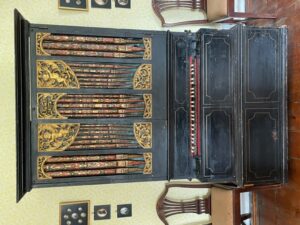
The autumn volume of Early Music Performer, the journal of the National Early Music Association, will include my article on the performance practice information to be gleaned from the L’Estrange manuscripts with particular reference to the organ. The L’Estranges were a staunchly royalist family who maintained a strongly musical household at their home in Hunstanton, Norfolk, in the mid seventeenth century. Their household musicians included Thomas Brewer and John Jenkins, both of whom assisted Sir Nicholas L’Estrange in compiling an important collection of consort manuscripts. Among the many fascinating details within the collection are the annotations that shed hugely interesting (and vanishingly rare) light on the ‘humouring’, or expressive realisation, of the music on the keyboard. We are fortunate in that we can link the manuscripts to the personalities, the place, and even the organ itself (which survives at Historic St Luke’s, Smithfield, Virginia) to provide a detailed context in which this music was played.

Gin & Topic…

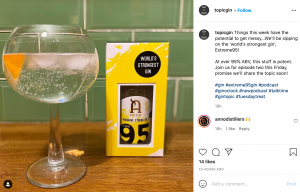
On Friday 9th April I am a guest on the podcast series Gin & Topic. I’ll be waffling about medieval and renaissance music with hosts Sarah and Áine whilst quaffing the splendid Anno Extreme95 – the world’s strongest gin. Not sure how coherent I was as a result of that, but it was good fun to record..!

BIOS Journal 2021

Next year’s Journal of the British Institute of Organ Studies will feature an article in which I explore a little-known aspect of the late seventeenth-century English organ, namely the use of sash-windows on case fronts. I’ve found just four organs that had this peculiar feature, and all were associated with buildings in which Christopher Wren was at work, so I suspect he was the instigator of the idea.

I first came across the feature whilst researching the so-called ‘King James’s Travelling Organ’, a consort organ that was sold to an American many years ago and of which the whereabouts are now unknown. I suspect it was an organ built, or possibly adapted, by Renatus Harris for one of the royal Catholic chapels, I think most probably the Whitehall one. In England the use of consort organs was an unusual feature of the royal Catholic chapels at this time and was based on the contemporary Italian practice of employing a small organo di legno with the choir. James II then used the organ in his temporary military chapel on Hounslow Heath during the Glorious Revolution, hence the ‘travelling’ epithet. More on the use of consort organs in the royal Catholic chapels will be coming soon.

Look out for the JBIOS article for more on this and some thoughts on the origins of the swell box…